
Introduction
India is now home to over 1 billion internet users — 70% internet penetration, the second largest online population in the world. The government has built thousands of digital services: DigiLocker, UMANG, Aadhaar authentication, EPFO portals, income tax filing, IRCTC, digital banking, e-KYC, exam portals, scholarship platforms. The promise of Digital India is real and ambitious — that every citizen, regardless of background, should be able to access government services, banking, employment, and education online.
But for differently abled Indians — who number over 2.68 crore registered and potentially 18-22 crore under broader definitions — this digital revolution has arrived with a silent asterisk: you are not fully included. Websites that screen readers cannot navigate. Banking apps with CAPTCHA that a VI person cannot solve independently. Government portals where the submit button has no label. Exam platforms where a VI candidate cannot upload their own photograph.
In this edition of CWC Spotlight, we look at India’s digital accessibility landscape — what the law says, what the courts have ordered, what has genuinely improved, and where the work still lies. This blog connects directly to our earlier editions: the JAWS screen reader cost barrier, the broken scribe system on exam portals, and the education pipeline gaps. All of them come back to one foundational question: is India’s internet built for everyone?
The honest answer is: not yet. But India is moving — faster than most people realise. And that movement deserves both recognition and honest scrutiny.
What the Law Says — The Framework Is Strong
India’s digital accessibility obligations are not vague suggestions. They are legal requirements backed by multiple statutes and now enforced by the Supreme Court.
The RPwD Act, 2016 — The Foundation
Sections 40, 42, and 46 of the Rights of Persons with Disabilities (RPwD) Act, 2016 collectively require that government bodies and service providers make their information and communication technology — websites, apps, digital documents, and platforms — accessible to differently abled persons within a specified time limit. Section 46 specifically gives service providers a statutory deadline: existing electronic content must be made accessible, and no new digital service can be launched without meeting accessibility standards.
Source: RPwD Act 2016 and Digital Accessibility — EqualWeb Analysis (2026)
GIGW 3.0 and IS 17802 — The Technical Standards
India has its own formal technical standards for digital accessibility. The Guidelines for Indian Government Websites (GIGW 3.0), updated in 2023, are explicitly aligned with WCAG 2.1 Level AA — the global benchmark for web accessibility — and are mandatory for all central and state government websites and mobile applications. Certification is issued through STQC (Standardisation Testing and Quality Certification Directorate), which audits against all 88 GIGW 3.0 mandatory checkpoints.
India also has IS 17802 — a national web accessibility standard published by the Bureau of Indian Standards (BIS), aligned with WCAG 2.1 Level AA. This is the standard referenced for ICT products and services across both government and private sectors.
Source: India Digital Accessibility Compliance — HalfAccessible (July 2026)
Supreme Court — Accessibility Is a Fundamental Right
In November 2024, the Supreme Court of India — in the landmark case Rajive Raturi vs Union of India — made a ruling that changed the nature of digital accessibility obligations in India permanently. The Court found that Rule 15 of the RPwD Rules, 2017 — which had used recommendatory language — was contrary to the intent of the RPwD Act, which requires mandatory compliance. The Court directed the Union Government to frame mandatory, enforceable accessibility standards within three months, covering all government buildings, websites, digital platforms, and the entire ICT ecosystem.
Source: DigitalA11Y — How India Is Strengthening Digital Accessibility Through Legal Mandates (2025)
Then in April 2025, the Supreme Court went further — in a ruling on accessible digital KYC processes, the Court declared that access to digital services is a fundamental right under Article 21 of the Constitution of India. The judgment issued 20 binding directions requiring all government and private reporting entities to appoint digital accessibility nodal officers, conduct periodic audits, and ensure that persons with visual impairments are included in user acceptance testing for every new digital service.
Source: Disability Rights India — SC Directions on Digital KYC Accessibility (May 2025)
SEBI — The Private Sector Now Has Deadlines
In the most significant private sector development in India’s digital accessibility history, SEBI issued Circular No. SEBI/HO/ITD-1/ITD_VIAP/P/CIR/2025/111 on 31 July 2025 — making digital accessibility mandatory for all SEBI-regulated financial entities. This covers stock exchanges, depositories, mutual funds, brokers, investment advisers, and all fintech platforms operating under SEBI’s regulatory umbrella.
The mandate requires compliance with WCAG 2.1, IS 17802, and GIGW 3.0 — with IAAP-certified accessibility audits completed by April 2026 and remediation of all findings by July 2026. CEO and CTO sign-off is required on the audit report, creating personal leadership accountability for compliance. SEBI followed up with a second circular on 29 August 2025 adjusting some timelines based on industry feedback.
Source: Deque — SEBI Sets New Standard for Digital Accessibility in Finance India (2025)
Source: DigitalA11Y — SEBI Mandates Digital Accessibility for Financial Industry India (2025)
Draft RPwD Amendment Rules 2026 — ICT for All Tech Companies
On 16 July 2026, the government published draft RPwD (Amendment) Rules 2026 proposing mandatory ICT accessibility requirements for all technology companies operating in India — including foreign firms. This is currently in the public comment period, with a six-month finalisation deadline. If implemented, India would become one of the few countries in the world to mandate digital accessibility across the entire technology sector, not just government and financial services.
The Ground Reality — What Is Actually Happening
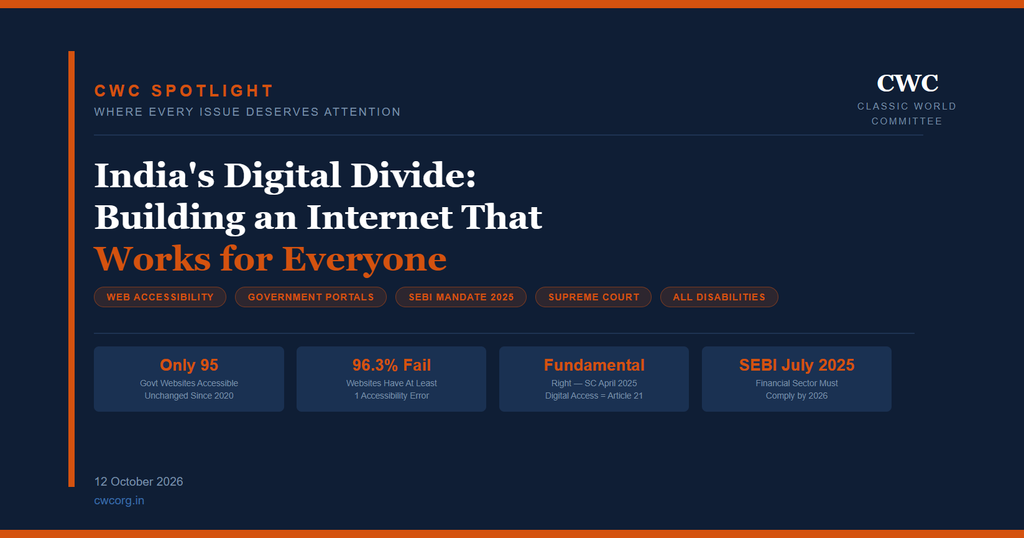
Only 95 central government websites have been made accessible since 2020 — a number that has not moved in four years. Out of 7,800 government websites tested, 5,815 had accessibility barriers.The Numbers Are Stark
Despite the legal framework and multiple court orders, the DEPwD’s Annual Report 2024 tells a sobering story. Only 95 central government websites have been made accessible — a number that has been stagnant since 2020. Of state and UT government websites, 676 out of 6,700 are accessible, with only 476 (7%) certified as live. The Union Government alone has over 4,142 websites — meaning the vast majority remain inaccessible.
Source: Newslaundry — Why Does India Fail to Address Digital Accessibility Gaps? (September 2024)
This is not just a government problem. Globally, 96.3% of websites still have at least one detectable accessibility failure in 2025. The average homepage carries 51 accessibility errors. Across one million websites, researchers found over 50 million distinct accessibility errors. And specifically — 70% of websites in the government, news, and e-commerce sectors are inaccessible to vision-impaired users. India is not an outlier on this front — but the scale of its differently abled population and the speed of its digital transformation make the gap here more consequential.
Source: Tenet — 80+ Web Accessibility Statistics 2026
Real Barriers — What Differently Abled Users Actually Face
For a VI professional using NVDA or JAWS, the barriers are not abstract. They are daily, practical, and often humiliating:
- CAPTCHA on government portals: The Aadhaar portal, the NTA exam website, and multiple banking platforms use image-based CAPTCHA that a screen reader cannot interpret. A VI person cannot log into their own Aadhaar account without sighted help
- PDF documents without OCR: Many government websites upload PDFs as scanned images — not searchable, not readable by screen readers. Laws, government orders, application forms, and circulars published in this format are completely inaccessible
- Unlabelled form fields: 22.1% of all website home pages have form inputs with no labels. A screen reader user hears ‘edit field’ with no indication of what to type
- Missing image descriptions: Charts, infographics, and diagrams without alt text — standard on most government and e-commerce sites — convey zero information to a screen reader user
- Exam portals specifically: As covered in our September blog, the SSC portal required face-recognition photo upload that a VI candidate cannot use independently — the Delhi HC had to specifically order a fix in July 2025
- No navigation markup: The Centre for Internet and Society’s study of 7,800 government websites found that more than half had no navigation markup — meaning a screen reader user cannot jump between sections, must read the entire page linearly, and cannot find what they need efficiently
Source: CyberPeace Foundation — Web Accessibility in India for PwD
The CAPTCHA Problem — A Specific Callout
CAPTCHA — Completely Automated Public Turing test to tell Computers and Humans Apart — is designed to block bots. But standard visual CAPTCHA, which asks users to identify images or solve visual puzzles, simultaneously blocks every screen reader user on the planet. It is a security feature that creates a built-in accessibility failure. The UIDAI website (Aadhaar), the NTA portal (UGC-NET, JEE, NEET), and multiple banking platforms still use image-based CAPTCHA as of 2024-25. Audio CAPTCHA exists and is widely used internationally — the barrier to implementing it is not technical, it is institutional awareness and prioritisation.
Beyond Visual Impairment — Digital Barriers Across Disability Categories
Digital inaccessibility is not only a VI issue. Every disability category faces its own specific digital wall — and most of them remain largely unaddressed.
Hearing Impairment — The Missing Captions and ISL Gap: For deaf and hard of hearing users, the primary barriers are different but equally limiting. Video content on government websites — public service announcements, scheme explainers, budget speeches, court proceedings streamed online — almost universally lacks captions or Indian Sign Language (ISL) interpretation. The SEBI July 2025 circular explicitly mandates that explainer videos must include captions and ISL interpretation — a landmark first for India. But outside the financial sector, the vast majority of government video content remains inaccessible. A hearing impaired citizen watching a health ministry scheme video, or a student watching an NPTEL lecture, receives no equal access to the content that their hearing peers take for granted.
Locomotor Disability — Mobile Accessibility and Touch Target Failures: For users with limited motor control — tremors, partial paralysis, or conditions affecting fine motor movement — small touch targets on mobile apps and websites are a significant barrier. 94% of mobile sites globally fail WCAG 2.2 AA standards, with touch target violations being the most common failure. India’s rapidly mobile-first internet makes this particularly acute: if an app button is too small to tap accurately, or if a form requires precise swiping gestures, users with locomotor differently abled conditions are effectively excluded. The RBI’s digital banking push and UPI’s dominance mean that inaccessible mobile apps are not a convenience issue — they are an economic exclusion issue.
Intellectual and Cognitive Disability — Plain Language and Navigation Complexity: Government websites and public portals are often written in dense, formal language with complex navigation structures. For users with intellectual disability, specific learning disability, or cognitive differences, this creates a barrier that WCAG 2.1 partially addresses through its ‘Understandable’ and ‘Operable’ principles — but that most Indian government websites do not yet implement. The Rajya Sabha website, official ministry pages, and statutory body portals are rarely tested for cognitive accessibility — meaning millions of differently abled citizens who could use these services independently simply cannot.
The November 2024 Supreme Court order and the SEBI July 2025 circular both use language that covers persons with disabilities broadly — not only VI. The mandate for audio descriptions, captions, ISL, plain language, and keyboard navigation without a mouse addresses multiple disability categories simultaneously. The challenge is that implementation awareness in India is still largely focused on VI — partly because screen reader testing is the most established accessibility testing method, and partly because the VI community has been the most vocal in advocacy. Closing this awareness gap — so that accessibility audits cover all disability categories, not just screen reader compatibility — is the next frontier.
Source: AllAccessible — Web Accessibility Statistics 2025 (Mobile Accessibility Data)
Source: L&E Global — India SEBI Mandates Digital Accessibility (ISL and Caption Requirements)
What Is Working — Genuine Progress Worth Recognising
Accessible India Campaign — Audit Infrastructure Being Built
The Accessible India Campaign (Sugamya Bharat Abhiyan), launched in 2015, has built a structured audit and certification framework. DEPwD has now empanelled multiple web accessibility auditors — with three lists published in February 2025, July 2025, and October 2025. Deque Systems, a world-class accessibility tools company, was formally empanelled as a government accessibility auditor in February 2025 — bringing internationally proven expertise to India’s compliance ecosystem. The October 2025 Expression of Interest for Phase 2 of empanelment signals further expansion of the auditor pool.
Source: DEPwD — Accessible India Campaign and Empanelled Auditors (October 2025)
Source: Deque — Officially Empanelled as Web Accessibility Auditor by Government of India (February 2025)
Anchal Bhateja — India’s First VI Woman to Argue Before the Supreme Court
In June 2025, Anchal Bhateja — a VI lawyer, disability rights advocate, and graduate of the National Law School of India University (NLSIU), Bengaluru — became the first VI woman to argue a case before the Supreme Court of India on 6 June 2025. The case she argued, the Sravya Sindhuri petition, challenged a Uttarakhand Judicial Service recruitment notification that reserved posts for differently abled persons but then excluded blindness and several other disabilities from the eligible subcategories — directly violating the RPwD Act 2016. The Supreme Court bench admitted the case for further hearing. Anchal built her legal career using screen readers, audiobooks, and Braille after losing her vision to retinopathy of prematurity. Her appearance before the Supreme Court is proof that when accessibility, education, and inclusion work together, differently abled professionals can reach the highest levels of any profession.
Source: Wikipedia — Anchal Bhateja, First VI Woman Advocate at Supreme Court (June 2025)
Source: The Logical Indian — Anchal Bhateja Challenges Uttarakhand Judicial Exclusion (June 2025)
SEBI — Leading the Private Sector Forward
The SEBI July 2025 circular is arguably the most significant single step in India’s private sector digital accessibility history. For the first time, a major Indian regulator has set binding deadlines, IAAP-certified audit requirements, and CEO/CTO sign-off accountability for digital accessibility in an entire sector. If SEBI’s framework delivers compliance in the financial sector by 2026-27, it becomes the template for every other Indian regulator — RBI, IRDAI, TRAI, and ultimately MeitY — to follow. The domino effect could transform India’s entire digital accessibility landscape within this decade.
IndiaAI Mission and AI-Powered Accessibility
India’s IndiaAI Mission (launched 2024) with its ₹10,371 crore allocation for AI infrastructure and research has an indirect but significant benefit for digital accessibility. AI-powered text-to-speech, real-time image description, automatic captioning, and intelligent document accessibility conversion are all becoming more capable and more affordable at speed. AI-powered screen reader adoption has grown 18% globally, and India’s AI investment positions it to build and deploy accessibility tools at a scale that would have been impossible five years ago. The intersection of India’s AI ambition and its differently abled population needs is an opportunity no one is yet talking about loudly enough.
Source: AllAccessible — Web Accessibility Statistics 2025
What Needs to Change — Building on the Momentum
For Government Portals — The 95 Must Become 4,000+
- The stagnation at 95 certified central government websites since 2020 must end. A time-bound, ministry-by-ministry compliance roadmap — with quarterly public reporting — should be mandatory. The STQC certification process must be accelerated and simplified for departments that are genuinely trying to comply
- Accessible by default, not accessible by audit — all new government websites and mobile applications must be built to WCAG 2.1 AA from the first line of code, with accessibility sign-off required before launch
- Image-based CAPTCHA must be phased out of all government platforms within a defined 12-month timeline, replaced with audio alternatives or invisible CAPTCHA that do not create barriers for screen reader users
- All PDF documents published from a government website must be tagged and OCR-enabled as a mandatory publication standard — not an afterthought. A circular from MeitY mandating this for all central ministries would be the simplest and fastest win available
For the Private Sector — Beyond Finance
- SEBI has shown that sector-by-sector mandates work. RBI must issue equivalent guidelines for all digital banking platforms. IRDAI for insurance apps. TRAI for telecom portals. Each sector mandate expands the accessible digital ecosystem for differently abled users
- India’s top 100 e-commerce and consumer platforms — Amazon India, Flipkart, Swiggy, Zomato, MakeMyTrip, Naukri — must be encouraged (and ultimately required) to meet WCAG 2.1 AA. Employment portals and education platforms are especially urgent given their direct impact on economic participation
- Employer accessibility policies: Companies that employ differently abled professionals must ensure that all internal enterprise tools — HR platforms, project management software, communication tools — are accessible. An inaccessible internal tool is the equivalent of a staircase in a building with no ramp
For the Broader Ecosystem
- The draft RPwD Amendment Rules 2026 must be finalised and notified without dilution. Mandatory ICT accessibility for all tech companies operating in India — including foreign firms — would place India alongside the EU, USA, and Australia as a global leader in digital inclusion law
- India needs an accessible digital grievance portal — where differently abled users can report inaccessible websites and portals, and receive a tracked, time-bound response. Currently, the CCPD can impose penalties for non-compliance, but the process for filing complaints is itself not fully accessible to screen reader users
- Developers and UX designers must be trained in accessibility from the beginning — in engineering colleges, design schools, and through professional certification programmes. Accessibility cannot remain a compliance afterthought; it must be a design first principle
For Differently Abled Users — Know What You Can Demand
- Under Section 46 of the RPwD Act, every service provider has a statutory obligation to make their digital services accessible. If a government portal is inaccessible, this is not a technical inconvenience — it is a legal violation you can report to the Chief Commissioner for Persons with Disabilities (CCPD) under Section 74
- The Supreme Court’s April 2025 judgment makes access to digital services a fundamental right under Article 21. This is not a minor legal point — it is the constitutional basis for demanding that every government digital service work with your screen reader
- Sugamya Bharat Abhiyan’s website lists empanelled accessibility auditors. If your organisation wants to improve its digital accessibility and does not know where to start, the DEPwD empanelled auditor list is the right starting point: depwd.gov.in/en/accessible-india-campaign/
Conclusion
India’s digital transformation is one of the great stories of this century — a billion people brought online, government services digitised, financial inclusion driven through mobile banking, and a startup ecosystem that has built world-class consumer technology. It is a story worth being proud of.
But a digital India that leaves out 2.68 crore registered differently abled persons — and potentially tens of millions more — is not a complete digital India. It is a digital India with an asterisk.
The good news is that the architecture for change is now in place like never before. The Supreme Court has declared digital access a fundamental right. SEBI has shown that sector mandates produce compliance. Three lists of empanelled accessibility auditors have been published. Draft rules to mandate ICT accessibility across all tech companies are in public comment. The CCPD has imposed penalties on non-compliant establishments. And Anchal Bhateja became the first VI woman to argue before the Supreme Court — challenging the exclusion of blind candidates from Uttarakhand’s judicial recruitment. India is building toward this.
India is building toward a more accessible internet. The question is not whether this will happen — the law, the courts, and the regulators have already answered that. The question is how quickly, and whether differently abled professionals and students in every city, every state, every sector will see the change in their daily experience before another decade passes.
At CWC, we will keep tracking this — because a digital India that works for everyone is not just a policy goal. It is the only kind of Digital India worth building.
© Classic World Committee (CWC) • cwcorg.in
CWC Spotlight: Where Every Issue Deserves Attention