
Introduction
There is a question that sits quietly in the minds of millions of differently abled professionals across India and in many countries around the world. We have a law. We have a reservation percentage. We have policy documents. But when we look at the actual offices, the actual desks, the actual payslips — are differently abled people truly there? Are all categories getting equal access? And does a number written in a government circular actually translate into real opportunity, real dignity, and a real career?
In this edition of CWC Spotlight: Where Every Issue Deserves Attention, we examine employment reservation for differently abled persons — not to blame any one country, not to praise another — but to look honestly at what works, what does not, and what still needs to be built. We cover India’s public sector, private sector, and entrepreneurship support, and compare honestly with the USA, UK, and Japan. Every country in this piece has something to learn — and something to teach.
India’s Framework — What the Law Actually Promises
India’s Rights of Persons with Disabilities (RPwD) Act, 2016 is one of the most comprehensive disability rights laws in the world on paper. It expanded recognised disability categories from 7 under the old 1995 Act to 21 categories — covering autism, thalassemia, acid attack survivors, sickle cell disease, Parkinson’s, and multiple sclerosis, among others. This puts India’s legal framework ahead of many developed nations in breadth of recognition.
The Act mandates 4% reservation in all central government jobs for persons with benchmark disability — certified at 40% or above. It also mandates 5% reservation in government and government-aided higher educational institutions. Unfilled reserved vacancies must be carried forward as backlog vacancies — they cannot legally be dropped. Importantly, the RPwD Act became the first Indian disability law to formally bring private employers with 20 or more employees within its scope, requiring them to provide reasonable accommodations.
[Source: : RPwD Act 2016 — Official Text, DEPwD]
India also runs a dedicated national skill development scheme for differently abled individuals: the National Action Plan for Skill Development of Persons with Disabilities (NAP-SDP), launched in 2015 and operating through the PM-DAKSH portal. It provides free vocational training to differently abled persons aged 15–59 with 40%+ certified disability, covering both short-term and long-term courses. Since its launch, 1.42 lakh differently abled individuals have been trained and approximately 28,000 placed in wage employment or self-employment — a meaningful number, but a fraction of the scale needed.
[Source: PIB India — Parliamentary Answer on NAP-SDP (2024)]
India’s Reality — The Gap Between Promise and Practice
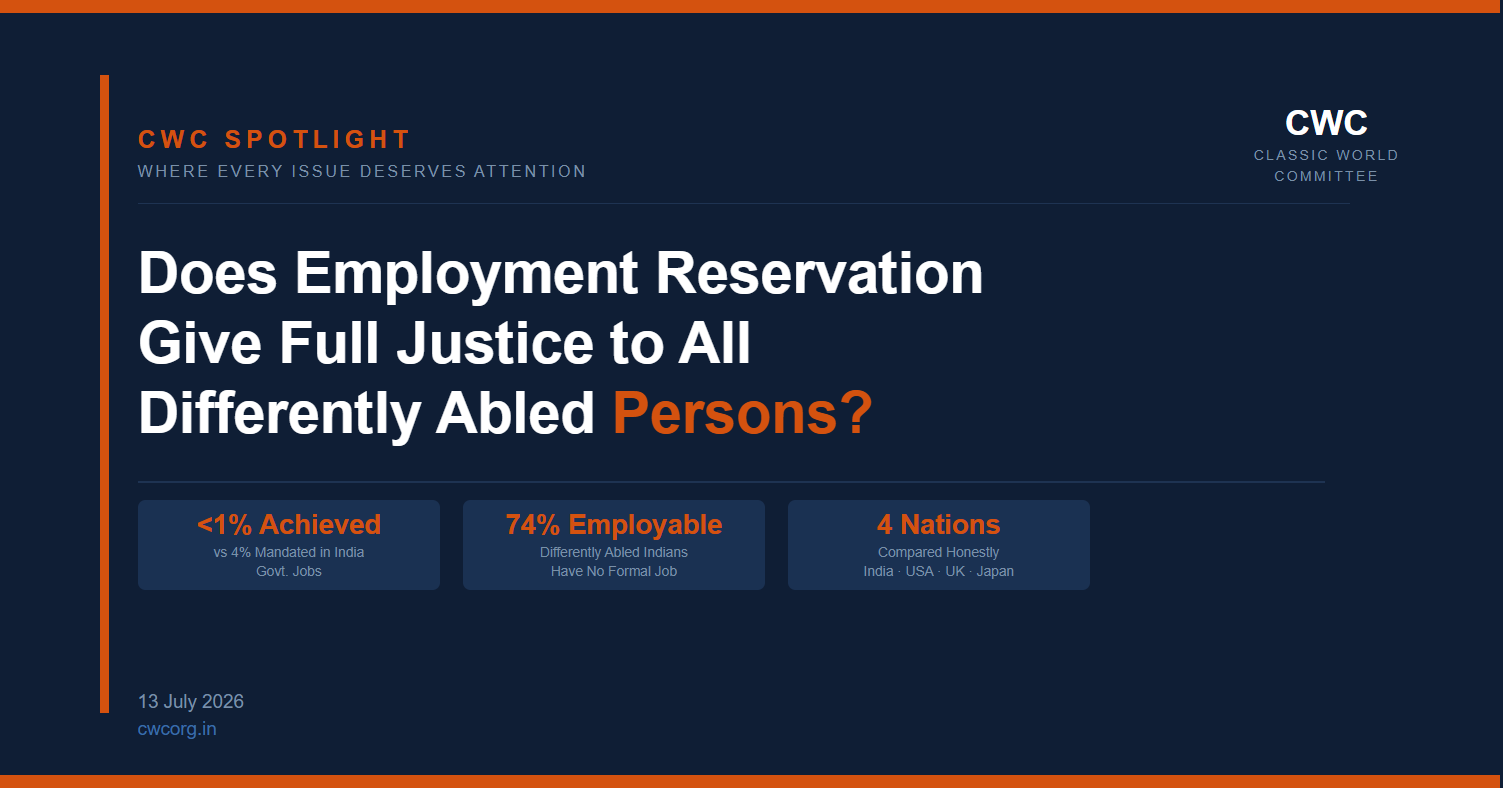
Despite a 4% mandate, DoPT data from 2020 shows differently abled persons hold less than 1% of central government jobs — one-quarter of the legal entitlement, years after the RPwD Act came into force.
[Source: SuperKalam — RPwD Act Analysis citing DoPT 2020 data]
A January 2026 study published in ScienceDirect tracked employment data from Assam’s Employment Exchange for 14 years (2010–2024). It found that PwD registrations grew by 61.6% and vocational training completions grew by 161% over this period — meaning training participation more than doubled. However, actual employment placements grew by only 56% — confirming a persistent and widening gap between training effort and real jobs. Both the 61.6% and 161% are growth percentages over 14 years, not proportions — meaning the numbers who completed training grew 2.6 times over this period, while placements grew at barely half that pace.
[Source: ScienceDirect — Time-Series Analysis of PwD Employment Accessibility, Assam 2010–2024 (Jan 2026)]
The scale of the problem nationally: of India’s approximately 3 crore registered differently abled persons, around 1.3 crore are considered employable. Of these, only 34 lakh have actually been employed. That means roughly 74% of employable differently abled Indians have no formal employment — reservation or no reservation.
[Source: Drishti IAS citing The Hindu, Feb 2025 / NCPEDP data]
The structural reasons are well documented:
Backlog vacancies quietly lapse: Reserved posts that go unfilled must legally be carried forward. In practice many departments delay advertising them for years — confirmed in court cases as recently as 2025, where posts identified in 2019 were still unfilled when advertised in 2023
21 categories but one combined quota: The 4% is not distributed meaningfully across all 21 disability types. VI, hearing impaired, and locomotor categories dominate placements — those with intellectual, psychosocial, or multiple disabilities rarely see the benefit of reservation in practice
Post identification incomplete: Departments must identify which posts are suitable for differently abled persons. Many have not — meaning even when a candidate exists, the department claims no post is ‘identified’ for them
Accessibility gap: A 2018 government report found only 3% of buildings in India were fully accessible. A 2022 CAG report found less than 25% of central government buildings were made accessible despite Accessible India Campaign targets from 2015. Reserving a seat means nothing if the person cannot reach the desk
India’s Private Sector — Where the Real Gap Lives
India’s private sector is where the majority of employment exists — and it is where differently abled inclusion is almost completely absent.
Despite being formally covered under RPwD Act 2016, private employers face no fixed quota and no meaningful financial penalty for non-inclusion. Only 0.28% of India’s private sector workforce is differently abled, and in MNCs the number falls to 0.05%. Among Nifty 50 companies in 2023, only 5 had more than 1% differently abled employees on payroll — and 4 of those 5 were public sector companies.
[Source: NCPEDP / Organiser India — From Welfare to Workforce, Feb 2026]
The RPwD Act’s ‘reasonable accommodation’ obligation for private employers exists on paper. Without a clear quota, a financial incentive structure, or a mandatory compliance reporting requirement, most private employers simply do not act on it — and are never held accountable. There is also a genuine small enterprise dilemma: a small business willing to hire a differently abled professional bears the full cost of assistive technology, workplace modification, and training adaptation with zero government support. Without that support, many quietly choose not to carry the burden.
Entrepreneurship — The Path India Has Partially Built
For those who cannot find formal employment, entrepreneurship has historically been both a refuge and a forced choice for differently abled individuals in India. To its credit, India has built several support structures here — though awareness and access remain serious challenges.
NHFDC — National Handicapped Finance and Development Corporation: Established in 1997 and wholly owned by the Government of India, NHFDC provides concessional business loans at 5–9% interest. Loan ceilings go up to ₹50 lakh for self-employment activities, covering service businesses, industrial units, transport, agriculture, and professional education. Women with disabilities receive an additional 1% rebate on interest. Repayment tenure is up to 10 years. Loans are channelled through State Channelising Agencies and select public sector banks.
[Source:NHFDC Loan Schemes — Vikaspedia / Official DEPwD]
Section 80U Tax Deduction: Differently abled individuals can claim income tax deductions of ₹75,000 to ₹1,25,000 under Section 80U depending on the severity of their condition — applicable to both employed and self-employed individuals.
India also has an inspiring real-world example of what differently abled entrepreneurship can achieve. Srikanth Bolla — born blind in rural Andhra Pradesh — became the first international VI student admitted to MIT, returned to India, and built Bollant Industries: an eco-packaging company with a ₹150 crore turnover that employs hundreds of differently abled workers. In February 2025, he appeared on Shark Tank India Season 4 as a guest shark — the first VI entrepreneur to do so — investing ₹85 lakh in a startup building wearable speech-to-text glasses for hearing and speech impaired persons.
[Source: Forbes India — Srikanth Bolla Profile (2024)]
But Srikanth Bolla’s story is exceptional precisely because it had to be. He fought for the right to study science in school. He was denied IIT entry despite 98% marks. Investors called his venture charity, not business. The support structures exist — but awareness, access, and attitude still lag significantly behind.
United States — Anti-Discrimination Without Quotas
The United States chose a fundamentally different approach. Rather than reservation, the Americans with Disabilities Act (ADA), 1990 prohibits discrimination in hiring, promotion, and dismissal, and requires all employers with 15 or more employees to provide reasonable accommodations. No seat is reserved — but no employer can legally reject someone because of their condition.
The ADA’s record is genuinely mixed. Studies from NBER and Yale’s Cowles Foundation show that in the years immediately after the ADA was enacted, employer anxiety about litigation costs caused some employers to hire fewer differently abled workers, not more. Between 1990 and 2013, employment rates for differently abled Americans actually declined. Over 90,000 discrimination complaints were filed between 1992 and 1997 — 63% for wrongful termination — showing the law was protecting existing workers more than opening doors for new ones.
[Source: Cowles Foundation Yale — Revisiting Employment Effects of ADA (2024)]
The more recent picture is more positive. By 2024, 22.7% of differently abled Americans were employed — the highest since records began in 2008. From July 2024 to August 2025, the employment-to-population ratio rose from 36.4% to 38.5%. Yale research also found the ADA increased employment chances by approximately 12 percentage points for differently abled workers whose conditions do not limit actual job performance.
[Source: EmployU — How ADA Transformed the Workforce (Bureau of Labor Statistics 2025 data)]
What works: No quota means employers hire on genuine fit. Broad protection regardless of disability type or percentage
What does not: Without a floor, employers can simply choose not to hire. Litigation-based enforcement is expensive and inaccessible for lower-income workers who need a job, not a court case
Honest verdict: Anti-discrimination alone produces gradual improvement over decades — but leaves the most vulnerable behind for the longest time
United Kingdom — Goodwill Without Accountability
The UK’s flagship approach is the Disability Confident Scheme — a voluntary certification programme through which employers self-declare their commitment to hiring and retaining differently abled workers. As of January 2026, approximately 19,000 employers were registered.
Research published in the British Journal of Industrial Relations (2024), based on data from 127,890 employees including over 5,600 differently abled workers, found that the proportion of differently abled workers is no higher in Disability Confident organisations than in non-Disability Confident ones. Among the elite ‘Leaders Group’, representation was actually slightly lower than non-member companies. The UK government acknowledged this failure itself in January 2026, announcing an overhaul and stating publicly that “for too long, it has not delivered enough support for disabled people”.
[Source: British Journal of Industrial Relations — Disability Confident Efficacy Study (2024)]
[Source: UK Government — Disability Confident Scheme Overhauled (Jan 2026)]
The disability employment gap in the UK has increased from 25 percentage points in 1990 to 30 percentage points in 2023 — three decades of voluntary goodwill with the gap growing, not shrinking. Differently abled workers in the UK move out of work at nearly twice the rate of non-differently abled workers, and move into work at less than one-third of the rate.
What works: 19,000 registered employers, wide awareness, government recognition that the scheme needs reform — accountability has finally entered the conversation
What does not: Employers can reach ‘Committed’ certification without hiring a single differently abled person. Voluntary always favours those already willing to be inclusive
Honest verdict: Thirty years of voluntary goodwill have grown the UK’s differently abled employment gap. Goodwill without accountability is not a policy — it is a hope
Japan — Quotas That Count People, But Not Always Dignity
Japan operates the world’s most structured mandatory quota system. The Statutory Employment Rate for private companies was raised to 2.5% in April 2024 and is planned to increase to 2.7% in July 2026. Companies that fail to meet the quota pay a levy per missing employee, redistributed as subsidies to compliant employers. Japan also launched a nationwide Employment Choice Support programme in October 2025, strengthening systems to help individuals select work arrangements suited to their abilities.
[Source: World Economic Forum — Japan Building Inclusive Workforce (Dec 2025)]
The numbers are impressive: 677,461 differently abled persons were employed in Japan in 2024 — an all-time high for the 21st consecutive year. The private sector employment rate has risen steadily from 1.46% in 2004 to 2.41% today.
But serious problems exist beneath the numbers:
Only 50% of companies meet the quota: Half of all companies pay the levy instead of hiring — treating the fine as a routine budget item
Data fraud at the highest level: In 2018, it was revealed that 27 out of 33 central government ministries had inflated disability employment records by approximately 3,700 people — the very institutions mandating the quota were falsifying their own compliance
Subsidiary segregation: Many large corporations create separate ‘special subsidiary companies’ to house differently abled employees — meeting the quota on paper while keeping them segregated from the main workforce
Retention is a crisis: Mental disability job retention at only 49.3% after one year, compared to 68% for intellectual disability and 60.8% for physical disability — the system brings people in but often cannot support them to stay
[Source: ISVD — Japan Disability Employment Quota — Structure and Limitations (Apr 2026)]
Honest verdict: Japan proves mandatory quotas with financial penalties produce measurable employment numbers. But 21 consecutive years of growth also show the slow pace even with strong enforcement. A seat at the desk is not the same as inclusion, equal treatment, or career growth
A Balanced View — What Every Country Shows Us
The Bigger Question — Is Reservation Enough at All?
Across every country studied here, one pattern is clear: reservation and anti-discrimination laws address access to employment. They do not automatically address what happens after someone gets in.
A differently abled professional who gets a reserved government job still faces:
Inaccessible buildings, digital systems, and internal software tools that their sighted or hearing colleagues never notice
Colleagues and managers with no awareness of their needs or rights under the law
Performance evaluation systems that treat speed and format as proxies for competence — disadvantaging those who work differently
No career progression support — reservation gets people in through the door, but promotions and senior roles remain overwhelmingly non-differently abled
Social isolation and attitudinal barriers that no law anywhere has yet effectively resolved
Employment is not just an entry point. It is a journey. And in most countries, the law only covers the door — not the staircase inside.
Our Suggestions — What Needs to Change
For India’s Public Sector and Policymakers:
Break the 4% mandate into category-wise sub-quotas so all 21 recognised categories receive proportionate access — not just the historically easier-to-place ones
Mandatory backlog vacancy filling timelines — carrying forward indefinitely is delay with a legal label, not compliance
A publicly available national compliance dashboard — every ministry and PSU should publish its differently abled employment data annually, as transparently as financial results
All government buildings, digital portals, and enterprise software must be made fully accessible — reservation without accessibility is a promise that cannot be kept
For India’s Private Sector:
A structured tax incentive for hiring and retaining differently abled employees — similar to Section 80JJAA for general employment — to shift the financial equation for small and medium enterprises
Government-funded assistive technology provision for private sector differently abled employees — so small employers who want to hire are not penalised by accommodation costs
Mandatory accessibility audits for companies above a certain size, with publicly disclosed results, creating accountability without requiring litigation
For Entrepreneurship Support:
NHFDC schemes are well designed but poorly known — a national awareness campaign reaching differently abled individuals below 35 would unlock significant latent entrepreneurial potential
NAP-SDP’s Entrepreneurship Development Programme should be expanded — and made digitally accessible with screen reader-compatible portals, particularly for VI participants
Startup India and similar programmes should recognise differently abled-led startups as a dedicated category with funding pathways — creating more pathways like Srikanth Bolla’s journey, without requiring that journey to be extraordinary
A Universal Lesson from All Four Countries:
Quotas without enforcement are targets, not guarantees — India and Japan both demonstrate this
Anti-discrimination laws without quotas protect existing workers but do not open enough doors — the USA demonstrates this across its first two decades of ADA
Voluntary schemes without accountability produce certificates, not jobs — the UK demonstrates 33 years of this
The most effective model requires all four working together: a legal employment floor through quotas, anti-discrimination protection inside workplaces, financial incentives for private employers, and genuine infrastructure accessibility. No country has fully delivered all four yet — and that is where the world still needs to go
Conclusion
Employment reservation for differently abled persons is not a failed idea. It is an incomplete one.
India has the most ambitious legal framework among the countries examined here — 21 recognised categories, 4% reservation, private sector coverage, dedicated entrepreneurship finance through NHFDC, a national skill scheme. India’s RPwD Act 2016 is more progressive in letter than the ADA, more binding than the UK’s voluntary scheme, and broader in scope than Japan’s quota-only model. That is genuinely something to acknowledge.
But a law that delivers less than 1% where it promises 4%, in a country where 74% of employable differently abled persons have no formal job, is a law with enormous unfinished work ahead of it.
The USA without quotas has reached record employment numbers but left the most vulnerable behind for decades. Japan with strict quotas has produced remarkable growth numbers but sometimes without dignity or genuine inclusion. The UK with good intentions and voluntary schemes has watched the gap grow wider for 33 years.
There is no perfect model anywhere in the world. But across all of them, one truth stands: when differently abled persons are given real access — not just paper access — they work, they build, they lead, they contribute. Srikanth Bolla was told he would be a burden. He built a ₹150 crore company and sat as an investor on national television. He did not need sympathy. He needed a fair chance.
Every differently abled professional deserves not just a reserved seat — but a real place at the table, a working desk, an accessible building, and a career path with no artificial ceiling.
At CWC, we will keep raising these questions — because every differently abled person deserves outcomes, not just percentages.
© Classic World Committee (CWC) | cwcorg.in