
Introduction
Imagine sitting at your office desk, ready to do your job – but the one tool you depend on to see the screen goes silent because someone forgot to renew a software licence. No warning. No backup. Just silence.
For thousands of VI professionals across India, this is not a hypothetical. It is a lived reality. The tool at the centre of this problem is JAWS – Job Access With Speech – the world’s most widely used screen reader. And the problem is simple but deeply damaging: it costs too much, it gets purchased but never upgraded, it is distributed through a single channel for the entire country, and it leaves some of the most hardworking individuals in our workforce stranded.
At CWC, we believe technology should be a bridge, not a barrier. In this edition of CWC Spotlight: Where Every Issue Deserves Attention, we shine a light on the JAWS cost crisis in India – who it affects, why it happens, and what needs to change.
What is JAWS? And Why Does It Matter?
JAWS, developed by Freedom Scientific (part of Vispero, USA), is a screen reader software for Microsoft Windows. It converts text on a computer screen into synthesised speech or Braille output, allowing VI professionals to navigate documents, websites, emails, spreadsheets, and applications – completely independently.
For a VI professional, JAWS is not optional software. It is the equivalent of a monitor, a keyboard, and a mouse – all in one. Without it, a computer is simply inaccessible.
According to the WebAIM Screen Reader User Survey (2024), JAWS holds around 41% of the global desktop screen reader market, making it the most-used screen reader in the world. Research published by the National Center for Biotechnology Information (NCBI) found that 100% of surveyed screen reader users in India regularly used JAWS – reflecting how deeply embedded it is in India’s professional and institutional landscape.
The Cost Problem: Purchase Price and Upgrade Costs
This is where the issue begins – and it does not end at the purchase price.
Purchase Cost
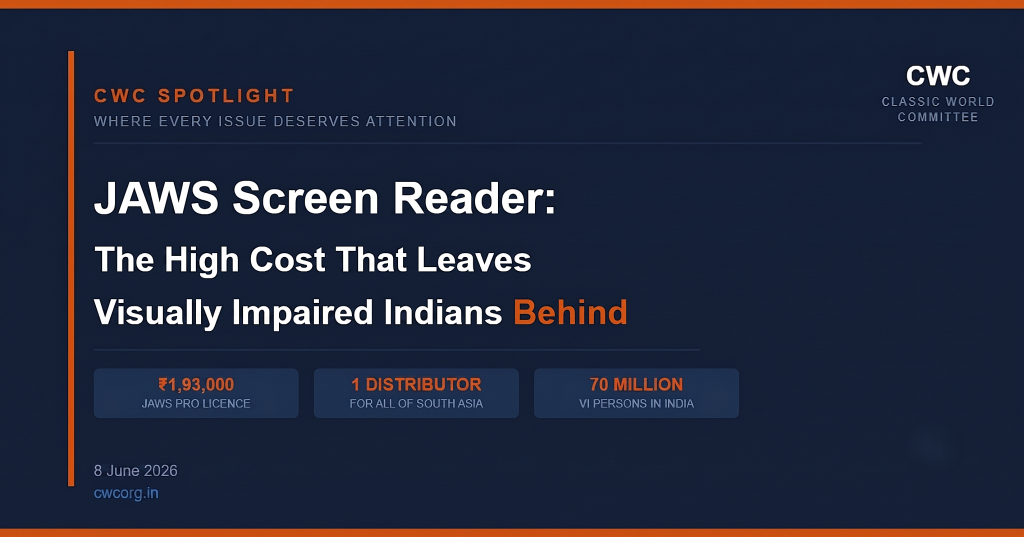
As per the official Vispero/Freedom Scientific product page, a JAWS Professional perpetual licence for a single user costs approximately USD 2,316.50 – roughly ₹1,93,000 at current exchange rates. Freedom Scientific does offer a Home Annual subscription at approximately USD 104.50 per year – however, as clearly stated on their own official website, this annual plan is currently only available to users in the United States.
Indian users have no access to this pricing. The perpetual professional licence at ₹1,93,000 is effectively the only official option available in India.
Upgrade Cost – The Hidden and Ignored Burden
Purchasing JAWS is only the beginning. To keep it working properly with updated versions of Windows, Microsoft Office, browsers, and enterprise applications, users need a Software Maintenance Agreement (SMA). As per Freedom Scientific’s official upgrade pricing page:
- One version upgrade: USD 400 (approximately ₹33,300)
- Two version upgrades: USD 800 (approximately ₹66,700)
- Three or more version upgrades: USD 1,200 (approximately ₹1,00,000)
- SMA renewal purchased late: additional USD 60
This means an organisation that bought JAWS years ago but skipped two rounds of upgrades now faces approximately ₹66,700 just to get current again – per user. For a public sector organisation with 50 VI employees, that is over ₹33 lakh in pending upgrade costs alone.
Without these upgrades, JAWS begins to fail – missing keystrokes, misreading modern websites, crashing on updated systems. It becomes, in effect, useless.
And this is exactly what happens across Indian public sector organisations: JAWS is purchased once, and then never upgraded. The differently abled employees using it are simply left to manage.
The Single Distributor Problem: A Silent Bottleneck
Here is a problem that rarely gets discussed – and it makes everything worse.
In India, there is only one authorised master distributor for Freedom Scientific’s JAWS software, operating out of Mumbai. This is not an assumption or a third-party claim – the distributor’s own website at karishmaenterprises.com explicitly describes them as the “Sole Authorized Distributors for India & the neighbouring countries like Bangladesh, Sri Lanka, Nepal, Bhutan, Burma, Pakistan & Afghanistan” for Freedom Scientific Inc., USA.
One company. One city. One and a half billion people across South Asia. This means any individual, organisation, school, or government department that wants to officially purchase JAWS, renew a licence, or access after-sales support must go through this single channel. There is no price competition, no regional alternatives, no local service network.
Think about a VI professional or a government office in Chhatrapati Sambhajinagar, Guwahati, Srinagar, Kanyakumari, Ujjain, Varanasi, Durgapur, or Bhubaneswar. For someone sitting in any of these cities, accessing licence renewals, technical support, or upgrade assistance through a single Mumbai-based distributor is a genuine daily barrier. Regional language support is limited.
Accessible customer service for VI users themselves is rarely discussed. And if this one distributor is unresponsive or unavailable, there is simply no other official route in the entire country.
Compare this to NVDA – free, downloadable globally by anyone, no gatekeepers, supported by an active international community. The contrast is stark, and it explains why so many VI professionals quietly move to NVDA out of necessity – not by choice.
The Public Sector Gap: Purchased but Never Upgraded
Many government departments and public sector organisations in India have procured JAWS licences for their VI employees. Section 34 of the Rights of Persons with Disabilities Act (RPwD Act), 2016 reserves 4% of government jobs for differently abled people, including 1% specifically for VI individuals. A Ministry of Finance directive dated November 2014 further directed all public sector organisations and financial institutions to provide assistive devices to differently abled employees.
On paper, the framework exists. The intention is there. But in practice, the ground reality is deeply concerning. The most detailed documented study on this issue remains the VIBEWA (Visually Impaired Banking Employees Welfare Association) Report, based on RTI applications filed across public sector institutions.
The full report is available at Read the VIBEWA accessibility report (opens in new tab) . While this study was conducted in 2016, no comprehensive sector-wide update has been published since – which is itself a serious policy gap that needs urgent attention.
Key findings from this documented study that remain structurally relevant today:
- More than 50% of VI employees surveyed had not been provided any screen reader at all, despite it being a mandated requirement under government directives.
- Across several public sector organisations, RTI data revealed a significant gap between the number of JAWS licences purchased and the number of VI employees who actually needed them – in many cases fewer than half had access to any working screen reader.
- One organisation provided the free NVDA screen reader to only a small fraction of its VI workforce, leaving the rest without any assistive tool whatsoever.
- Across most organisations surveyed, assistive technology was not being updated to newer versions – directly confirming that the upgrade cost problem is real, widespread, and ongoing.
- In a significant number of institutions, more than 50% of VI employees reported that internal software and online portals were either completely or partially inaccessible with their screen readers – meaning even the tools they had were largely ineffective in real work conditions.
The pattern is clear: procurement without maintenance, licences without upgrades, policy on paper but not in practice. Until a fresh nationwide survey is commissioned and published, this report remains the most credible evidence we have of a crisis that has not been resolved.
The Private Sector Reality: A Different Kind of Barrier
If the public sector situation is concerning, the private sector reality is more complex – and equally damaging.
The Performance Trap
Private sector jobs demand efficiency, speed, and measurable output. Employees are evaluated on results. For a VI professional in a private company, this pressure is made harder by an accessibility problem they have no control over.
Many modern enterprise tools – project management platforms, CRM software, internal portals, financial applications, and data dashboards – are not fully accessible even to the most advanced screen readers. The situation becomes particularly difficult when JAWS, which offers deeper compatibility with enterprise software than any free alternative, is simply not available.
A VI employee is then forced to use NVDA or other tools to navigate websites and applications that may be only partially compatible. Tasks that a sighted colleague completes in minutes can take significantly longer – not because of any lack of skill or effort, but because of a preventable technology gap.
When performance reviews come around, this gap is rarely considered. The VI employee pays the price professionally, for a problem that is entirely institutional.
The Small Business Dilemma – A Double-Edged Sword
Many large MNCs and well-resourced private companies have started including assistive technology provisions in their HR and diversity policies. This is welcome. But what about the small business, the medium enterprise, the growing startup that genuinely wants to hire a differently abled candidate?
Here lies a serious unintended risk. If any law or policy were to make JAWS procurement mandatory for every employer of a VI professional, small enterprises – which do not have large HR budgets or dedicated accessibility teams – may simply stop hiring VI candidates altogether.
Their thinking would be practical and blunt: why take on a ₹1,93,000 software cost per employee, plus annual upgrade bills, when other candidates are available who do not come with that financial obligation?
This is not a hypothetical concern. It is the kind of quiet, undocumented employment discrimination that happens when well-intentioned policies are designed without accounting for cost realities at ground level. The answer is not to remove the expectation of providing assistive technology – it is to make that technology affordable, subsidised, or government-funded enough that hiring a VI professional never becomes a financial burden to an employer who is willing to be inclusive.
The goal must be to make inclusion easy – not to make it mandatory in a way that makes it expensive, and therefore quietly avoided.
Why This Issue Goes Unnoticed
There are a few honest reasons this problem rarely reaches public conversation.
1. VI professionals are often reluctant to raise complaints publicly for fear of being seen as difficult or dependent. They adapt, they manage, they stay quiet.
2. The technology is invisible to sighted colleagues and managers. When JAWS stops working properly, there is no visible sign. The employee simply becomes slower and more stressed – which is often misread as a performance issue rather than an institutional technology failure.
3. Procurement decisions in government and public sector organisations typically prioritise the initial purchase cost over long-term maintenance. Upgrading a software licence does not make a headline, so it does not get prioritised in annual budgets.
4.With a single distributor servicing the entire country, many organisations outside major metros do not receive adequate follow-up, support, or awareness about upgrade requirements.
The result: a genuine, solvable problem quietly persists – year after year.
What Is Available: Alternatives and Partial Solutions
While we advocate for better JAWS access, it is important for VI users to know their current options.
NVDA (NonVisual Desktop Access) – Free, open-source, and highly capable for everyday tasks. Available at Download NVDA Screen Reader (opens in new tab) . Strongly recommended for self-employed individuals and private sector employees whose organisations will not fund JAWS.
Indo NVDA – A customised version of NVDA built specifically for Indian languages including Hindi, Marathi, Bengali, Kannada, Tamil, and Telugu. A significant resource for VI users working in regional language environments.
Microsoft Narrator – Built into Windows 10 and 11, completely free, and requires no installation. However, it is important to be honest here: Narrator remains significantly limited compared to both JAWS and NVDA for professional use. This is worth contrasting with how Google has approached the same challenge on Android, where TalkBack – the built-in screen reader – is tightly integrated into the operating system and widely considered a reliable, well-maintained tool for everyday use. Microsoft has not achieved the same level of quality with Narrator on Windows, and for professional tasks, it cannot be treated as a genuine substitute.
JAWS 40-Minute Demo Mode – JAWS runs for 40 minutes per session without a licence. Not practical for daily professional work, but useful for training or evaluation.
JAWS Home Annual Licence – Freedom Scientific offers an annual subscription at approximately USD 104.50 per year for personal, non-commercial use. Important for Indian readers: this plan is officially only available to users in the United States as per Freedom Scientific’s own website. Indian users cannot access this pricing through the official channel. This makes the full ₹1,93,000 perpetual licence the only official route for any Indian user – individual or organisational.
A Big Opportunity: India Can Build Its Own Solution
Here is something worth saying clearly: the screen reader market in India is a wide-open opportunity.
India is already a global leader in software development, AI research, and IT services. With modern AI-based text-to-speech technology, natural language processing, and accessibility APIs readily available, building a reliable, locally developed screen reader is no longer the engineering challenge it once was. Early research in this direction has already happened right here – IIT Hyderabad published research on a multilingual Indian language screen reader called RAVI, demonstrating that the technical foundation exists within our own institutions.
At the 2023 Awareness Conclave on Assistive Technology, experts specifically called for Indian innovation to fill the gap left by expensive Western products. At the Ministry of Social Justice and Empowerment’s 6th Conference on Empowering Differently Abled Persons (July 2024), the ministry secretary stated directly that technology can not only bridge gaps but also create opportunities for innovation and entrepreneurship.
The opportunity is real. An Indian company – startup or established enterprise – that builds a well-tested, multilingual screen reader, officially certified and compatible with Windows and common enterprise software, would be addressing a genuine and urgent national need. Government procurement alone, across ministries, PSUs, public sector organisations, and educational institutions, represents a substantial and recurring revenue stream.
Priced affordably at even ₹2,000–3,000 per user per year, such software would undercut JAWS by over 90% while serving VI professionals far better than the self-supported NVDA model. More importantly, it would be India’s gift to the world: affordable, multilingual, AI-powered, and built with the specific needs of Indian professionals in mind.
If you are already working on something like this, CWC would genuinely love to hear from you.
Our Suggestions: What Needs to Change
For Government and Public Sector Organisations: Procuring JAWS is not enough. Budget allocation for assistive technology must include mandatory annual upgrade and maintenance costs. The Ministry of Finance directive from 2014 needs to be revisited and strengthened with specific upgrade timelines and real compliance monitoring – not just purchase records.
For Private Sector Employers: The RPwD Act 2016 places a reasonable accommodation obligation on private employers as well. Funding a screen reader licence for a VI employee is a reasonable accommodation – and simply the right thing to do. HR and procurement teams must be made aware of this responsibility.
For Policymakers: India needs a national assistive technology subsidy programme where VI individuals can access professional screen readers at zero or heavily subsidised cost. The Department of Empowerment of Persons with Disabilities (DEPwD) is well-positioned to lead this. Critically, any policy mandating assistive technology provision must be paired with financial support for small enterprises – so that inclusion becomes easy, not costly.
Regarding Distribution: International assistive technology companies must be encouraged to expand their authorised distributor networks in India well beyond a single city – enabling regional service, regional language support, and genuine price competition nationwide.
For VI Professionals: Know your rights under the RPwD Act 2016. Differently abled employees are entitled to reasonable workplace accommodations. If your employer has not provided functional assistive technology, you have the right to formally request it. CWC is here to support you in that process.
Conclusion
The story of JAWS in India is ultimately a story about dignity – the dignity of being able to do your job with the same tools your colleagues take for granted.
A screen reader is not a luxury. It is a necessity. And when the institutions that employ VI professionals fail to fund, maintain, and upgrade that necessity, they are not just cutting a budget line – they are cutting off access to work itself.
At CWC, we will keep shining this light. If this issue affects you or someone you know, reach out to us. Share this blog. Start the conversation in your workplace. And if you are someone who can build the solution India needs – we are ready to stand behind you.
Every ignored issue deserves a voice. That is exactly what CWC Spotlight: Where Every Issue Deserves Attention is here to provide.
© Classic World Committee (CWC) | cwcorg.in