
Introduction
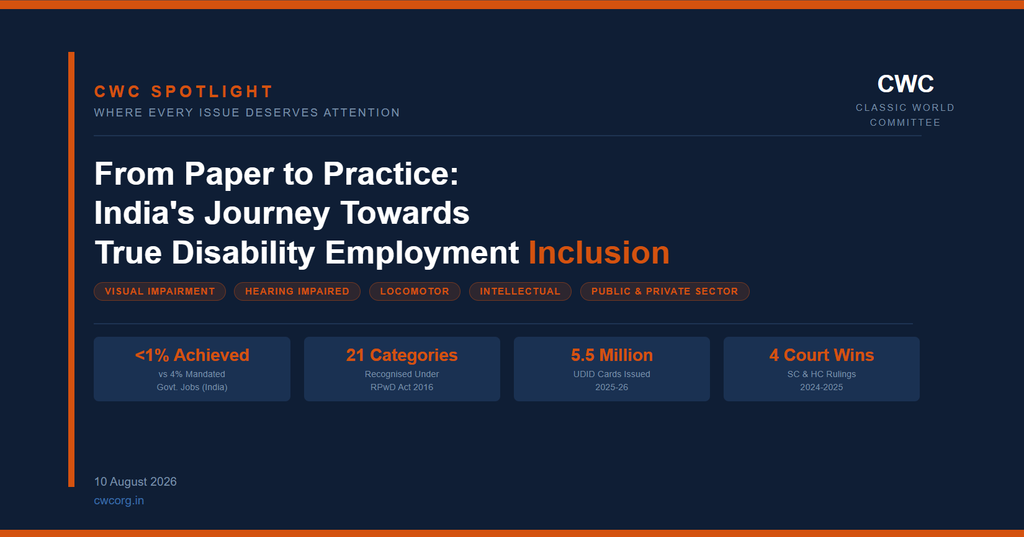
India has one of the most progressive disability rights laws in the world. The Rights of Persons with Disabilities (RPwD) Act, 2016 – passed by Parliament on 14 December 2016 and in force from 19 April 2017 – expanded recognised disability categories from 7 to 21, raised reservation in government jobs from 3% to 4%, and formally brought private sector employers within the ambit of reasonable accommodation obligations for the first time. On paper, India has built something genuinely ambitious.
In our previous editions of CWC Spotlight, we looked at the global picture of disability employment policy, and at the technology barriers – like the high cost of screen reader software – that hold VI professionals back. This edition focuses on India alone, going deeper into what is actually happening on the ground. What has the government done in the past few years? What is working? Where are the gaps? What does the experience look like across different disability categories in both public and private sectors?
This blog is not about blame. It is about building. India has the intent, the legal framework, and a growing body of court judgments pushing for real implementation. What it needs now is momentum – and an honest conversation about where the work still lies.
What India Has Built – Recognising the Progress
Before examining the gaps, it is important to genuinely acknowledge what has been achieved – because meaningful progress has been made and deserves recognition.
The RPwD Act 2016 – A Landmark Framework: By expanding from 7 to 21 disability categories, India recognised conditions like autism spectrum disorder, muscular dystrophy, multiple sclerosis, thalassemia, sickle cell disease, acid attack survivors, and Parkinson’s disease within the formal disability rights framework for the first time. This is broader than many developed countries use. The Act guarantees the right to free education up to 18 years, 5% reservation in higher educational institutions, age relaxation of 5–10 years in government recruitment, and the right to reservation in promotions – a provision that took years and multiple court orders to implement but is now formally established.
[Source: RPwD Act 2016 – Official DEPwD]
UDID – Unique Disability Identity Card: One of the most practical steps India has taken is the Unique Disability Identity (UDID) card system. Over 5.5 million UDID cards have been issued as of 202526, creating a portable, verifiable digital identity for differently abled persons that removes the need to reobtain certificates for every government scheme or job application. Submission and processing moved fully online in FY 202425.
[Source: IMPRI India – RPwD Act 2016 Challenges and Progress (May 2026)]
Skill Development at Scale: From 2023 to 2025, the National Action Plan for Skill Development of Persons with Disabilities (NAPSDP) significantly expanded its reach. Over 1 lakh differently abled persons were trained and placed across sectors, integrating vocational training, digital literacy, and entrepreneurship programmes with new online and mobileaccessible formats improving reach into rural areas.
DEPwD Budget Growth: From 201314 to 202324, the Department of Empowerment of Persons with Disabilities budget grew from ₹560 crore to ₹1,225 crore – the highest in a decade – with actual expenditure of ₹1,143 crore in 202324. For 202526, ₹1,275 crore has been allocated. This sustained budget growth reflects genuine institutional commitment.
[Source: Psychology Town – Key Government Schemes for PwDs in India (March 2026)]
Supreme Court Landmark – VI Candidates in Judicial Services (March 2025): In a landmark judgment in March 2025, the Supreme Court held that visually impaired persons cannot be denied the opportunity of employment in judicial services. The Court struck down a Madhya Pradesh Judicial Services rule that had barred VI and low vision candidates, underlined the importance of substantive equality, and directed that differently abled persons must receive affirmative action, not exclusion. This ruling has set a powerful precedent across all state and central recruitment.
[Source: Supreme Court Observer – VI Candidates Cannot Be Excluded from Judicial Services (March 2025)]
Reservation in Promotions – Finally Moving: After years of legal battles, the government issued a DoPT Office Memorandum in December 2023 clarifying reservation in promotions for persons with benchmark disabilities, followed by implementation guidance in March 2024. The framework for notional promotions and supernumerary posts is now formally in place – something contested and delayed for over a decade.
[Source: Lukmaan IAS – Reservation in Promotions for PwD (January 2024)]
How the 4% Reservation Is Structured
The 4% reservation in central government jobs is not one undivided block. It is structured as 1% for each of four broad disability groups:
- 1% – Blindness and low vision
- 1% – Deaf and hard of hearing
- 1% – Locomotor disability (including cerebral palsy, dwarfism, acid attack victims, muscular dystrophy, leprosy cured)
- 1% – Autism, intellectual disability, specific learning disability, and mental illness (including multiple disabilities and deafblindness)
[Source: Careers360 – PwD Recruitment Data and Category Breakdown (December 2022)]
In addition, posts must be formally “identified” as suitable for each disability subcategory before reservation can be applied. A post not formally identified cannot carry a reservation – creating a structural bottleneck that affects all four categories, but most severely those in newer, less understood categories like autism and psychosocial disability.
The Public Sector Reality – Honest Assessment
Despite strong legal architecture, the gap between the 4% target and actual outcomes remains significant and well documented.
The Chief Commissioner for PwD’s Annual Report 202324 noted that fewer than 60% of Group A central PSU vacancies are filled at the 4% level, with carryforward backlogs still pending across many ministries. Earlier DoPT data from 2020 showed differently abled persons holding less than 1% of central government jobs overall – confirming that even years after the law came into force, the mandate has not been met.
[Source: Right to Information Wiki – How to Claim 4% Disability Reservation (2026)]
Between 2018 and 2021, the government reported that 4,798 differently abled candidates were directly recruited in central government posts – a real and meaningful number. But set against the total scale of central government recruitment in the same period, it reflects how far below the 4% benchmark actual implementation sits.
[Source: Careers360 – Lok Sabha Answer on PwD Recruitment 20182021 (December 2022)]
The key structural reasons for this gap:
- Post identification incomplete: Departments must formally identify which posts are suitable for which disability subcategory. Without this, recruitment cannot proceed even when quota slots exist. The Delhi High Court directed fresh uniform guidelines for identification in 2024 – still being implemented across departments
- Backlog vacancies lapse: Reserved posts not filled must be carried forward legally. In practice many go unadvertised for years. A locomotor disability candidate who cleared SSC CGL 2024 was told his target post was ‘nonidentified’ – a situation repeated across thousands of cases annually
- Inconsistent scribe and examination support: Writer availability, accessible question papers, and extended time are provided inconsistently across different recruiting agencies – UPSC, SSC, RRB, IBPS, and state PSCs each have different standards
- SIPDA budget concerns: The SIPDA scheme budget dropped from ₹240 crore in 202223 to ₹115 crore in 202526 – even as Supreme Court orders on accessibility have increased legal obligations. This funding trajectory needs urgent review
CategoryWise Picture – Who Is Getting Justice and Who Still Needs More
Visual Impairment – The Totally Blind vs Low Vision Gap:
Within the VI category, a deeply problematic institutional bias has been documented and is now being actively corrected by courts. Many organisations historically preferred low vision candidates over totally blind ones – assuming they would be easier to accommodate. This bias disadvantages those who are more severely impaired and need the protection of reservation most.
In November 2024, the Karnataka High Court issued a landmark ruling in the case of H.N. Latha – a totally blind candidate rejected for a government teacher post despite being in the selection list. The Court held that candidates with absolute blindness deserve preferential consideration over those with low vision, provided their disability does not impede the duties required. The Court notably cited Srikanth Bolla, CEO of Bollant Industries, among the inspirational figures it referenced in its judgment – underlining that blindness is not a barrier to professional excellence.
[Source: Business Standard – Karnataka HC Priority to Absolute Blindness (November 2024)]
Earlier in 2024, the Delhi High Court ruled that blind candidates cannot be excluded from Airports Authority of India posts if they can effectively perceive and perform the duties attached – directly challenging blanket exclusions based on visual impairment severity.
[Source: Disability Rights India – Karnataka HC Full Ruling Analysis (November 2024)]
These rulings are correcting a real bias – but the fact that they required High Court intervention, rather than proactive employer policy, tells us where attitude change still needs to happen at the institutional level.
Hearing Impairment – Progress with Persistent Barriers:
The hearing impaired community – estimated at 50.7 lakh (Census 2011) – faces a specific challenge in that most workplaces and examination systems are not designed for sign language communication. India does not yet have a national sign language interpreter registry, meaning even willing employers cannot always easily find qualified interpreters for interviews or daytoday workplace needs.
Some encouraging private sector developments are worth highlighting. Amazon India now provides sign language interpreters for job interviews and captioning for companywide meetings. Infosys has created its ‘Infyability’ resource group, placing hearing impaired employees across roles excluding only those requiring telephonic customer interaction. Mirakle Couriers in Mumbai has built an entire business model around hearing impaired delivery staff – demonstrating that a welldesigned workplace can make hearing impairment entirely irrelevant to professional performance.
[Source: Unspoken Language Services – Deaf Rights in India Workplace (November 2023)]
However, a 2023 CAG Report on Digital Accessibility found that less than 15% of central government digital platforms were accessible to hearing impaired users – meaning even when jobs are available, the digital tools to do them are often not designed for inclusion.
[Source: Psychology Town – Breaking the Silence: Challenges for Hearing Impaired in India (March 2026)]
Locomotor Disability – The Largest Category, Still Facing Gaps:
At 54.6 lakh registered (Census 2011), locomotor disability is India’s largest disability category and has the longest history of inclusion in government recruitment. Yet it continues to face the ‘nonidentified post’ barrier most frequently – where departments claim a post has not been designated suitable, blocking reservation application. The DoPT’s January 2021 consolidated identifiedposts list brought some clarity, but statelevel and departmental implementation remains uneven.
Tamil Nadu has shown what proactive state policy looks like: its MSME Department offers a seed fund for startups led by differently abled persons and payroll subsidies for SMEs employing over 25% of their workforce from this community. This statelevel policy innovation is exactly the kind of model that should be studied and replicated nationally.
[Source: UNDP India – Bridging the Gap: Disability Inclusion in Private Sector (2024)]
Intellectual, Psychosocial, and Multiple Disabilities – The Most Overlooked:
The fourth 1% category – covering autism, intellectual disability, specific learning disability, mental illness, and multiple disabilities – remains the most neglected in employment across both public and private sectors. Institutional understanding here is weakest, post identification is rarest, and stigma runs deepest.
UDISE+ 202324 data shows that while 21 lakh differently abled children are enrolled in schools, dropout rates spike sharply after Class 8 – precisely when academic demands increase and support structures decrease. Without secondary education completion, reaching formal employment becomes structurally very difficult. The education pipeline is the employment pipeline – and for this category it is leaking severely at exactly the wrong point.
[Source: IMPRI India – RPwD Act Implementation Challenges (May 2026)]
The Private Sector – Early Signs of a Shift
India’s private sector formally came under the RPwD Act 2016 – a historic first – but without a quota mandate or financial penalty, commitment remains voluntary in practice. Large corporations are beginning to move, but small and medium enterprises lag significantly behind.
The overall differently abled workforce participation rate in India stands at 36% – compared to 60% for nondifferently abled workers. In the formal private sector, MNCs employ only 0.05% differently abled persons in their workforces – almost invisible representation.
[Source: UNDP India – Bridging the Gap: Disability Inclusion in Private Sector (2024)]
However, there are genuinely encouraging signals:
- Infosys, Amazon India, Wipro, and TCS have all developed internal diversity and inclusion policies specifically addressing differently abled employees – covering hiring, accommodation, and retention
- Mirakle Couriers demonstrates that a business built around differently abled workers is commercially viable and replicable – not charity
- Tamil Nadu’s MSME payroll subsidy makes inclusion financially accessible for small businesses – a model other states should consider
- Remote work and digital onboarding trends – accelerated by COVID – have inadvertently made employment more accessible for many differently abled professionals who previously faced physical access barriers
The challenge is that these positive examples remain islands, not a mainland. For every large employer with an inclusion policy, there are thousands of smaller employers who have never considered it – not out of malice, but because no one has made it easy or explained why it matters for their business.
What Needs to Change – Building on What India Has Started
For the Public Sector:
- Complete the post identification process – all ministries and departments should publish their identifiedposts lists annually, and the DoPT should set a firm deadline for full completion
- Backlog vacancies must have mandatory filling timelines with a dedicated monitoring mechanism. The Chief Commissioner for PwD should publish quarterly compliance data publicly – the same way financial accounts are published
- The SIPDA budget reduction from ₹240 crore to ₹115 crore deserves urgent reversal. Accessibility infrastructure is not optional – it is now a legal obligation under multiple Supreme Court orders
- All government recruiting agencies (UPSC, SSC, RRB, IBPS, state PSCs) must standardise scribe/writer policies, accessible examination formats, and extended time provisions – uniformly across the country, not case by case
For the Private Sector:
- A structured tax incentive for hiring and retaining differently abled employees – similar to Section 80JJAA for general employment – would shift the financial equation, especially for small and medium enterprises
- Mandatory accessibility audits for companies above a certain size, with publicly disclosed results, creating accountability without requiring litigation
- Governmentfunded assistive technology provision for private sector differently abled employees – so small employers who want to hire are not penalised by accommodation costs. The screen reader access barrier detailed in our earlier CWC Spotlight blog is one clear example
For Differently Abled Persons – Know Your Rights:
- Every differently abled person with a benchmark disability certificate is entitled to RTIbased access to reservation roster data from any recruiting agency. This is a powerful tool – use it
- The Chief Commissioner for Persons with Disabilities (CCPD) is a statutory authority with civilcourt powers under Section 74 of the RPwD Act – complaints about noncompliance in central government employment can and should be filed here
- Postselection exclusions based on assumptions – like ‘a blind person cannot do this job’ – are legally challengeable, as Karnataka HC and Delhi HC have both confirmed in 2024. Document your situation and seek legal guidance
Conclusion
India’s story on disability employment is not one of failure – it is one of a nation building something significant, while still learning how to fully deliver on what it has promised.
The RPwD Act 2016 gives India a legal foundation stronger than most countries. The UDID system is creating real digital infrastructure. Supreme Court and High Court judgments in 2024 and 2025 are closing loopholes that institutions have historically exploited to avoid inclusion. Budget allocations for DEPwD have grown substantially. Skill development has reached over a lakh individuals in two years. These are not small things.
And yet – post identification remains incomplete across many departments. Backlogs accumulate quietly. The totally blind candidate can still lose to the low vision candidate for a seat that should serve both. The hearing impaired professional still cannot always find a government interpreter when they need one. The person with intellectual disability or mental illness remains furthest from the formal economy, their 1% quota the least realised of all four.
The path forward is not to start over. It is to enforce what exists, fund what is mandated, and expand what is working. And most importantly – to keep listening to differently abled professionals themselves, who understand the gaps better than any policy document ever will.
At CWC, this is the conversation we are committed to keeping alive. Because every differently abled person deserves not just a right written in law – but a reality that genuinely reflects it.