
Introduction
In our previous editions of CWC Spotlight, we asked hard questions about employment. We looked at how the JAWS screen reader costs over ₹1,93,000 for Indian VI professionals with no affordable alternative. We examined whether global disability employment policies actually deliver. And in our August edition, we showed that India’s RPwD Act 2016 — despite being one of the world’s strongest disability laws — still delivers less than 1% of central government jobs to differently abled persons against a 4% mandate.
But employment is the end of a pipeline. Before a differently abled person can demand their right to a job, they need to have completed their education — and navigated an examination system built largely without them in mind. This is where the problem is deepest, and least talked about.
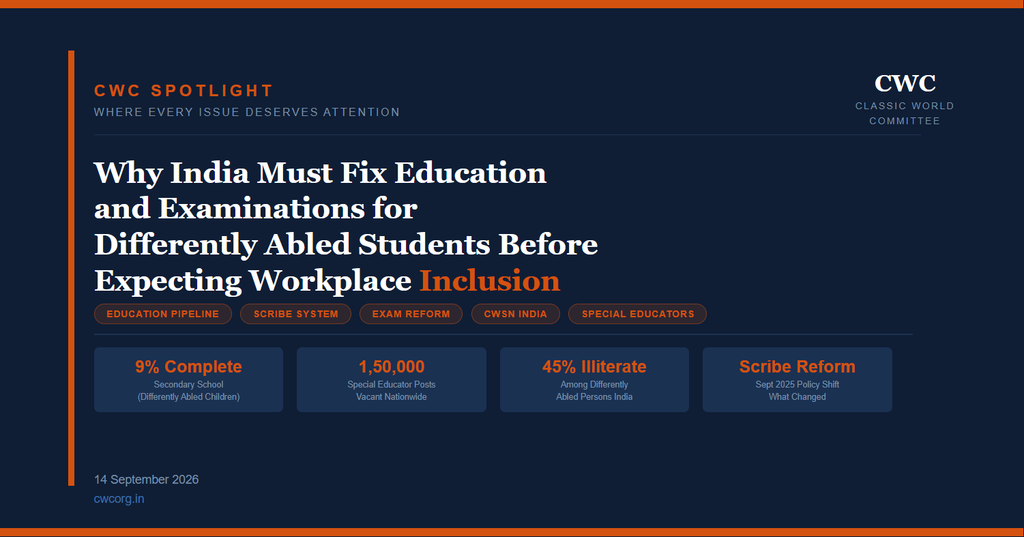
Only 9% of differently abled children complete secondary school. 45% of differently abled persons in India are illiterate. Just 0.86% of total school enrolment is differently abled — against an estimated population share of 2–3%.
Source: JKPI Research — Inclusive Education for Children with Disabilities in India (January 2024)
Source: Education For All in India — CWSN Enrolment UDISE+ 2024-25 Analysis (October 2025)
This blog covers both sides of this challenge — the education system and the examination system — because they are two parts of the same pipeline. Fix one without fixing the other, and the leak continues.
What India Has Built — The Framework Deserves Recognition
India has constructed a meaningful and multi-layered framework for inclusive education. Before examining the gaps, it is important to genuinely acknowledge what exists — because the architecture is serious and deserves respect.
The Legal Foundation
The Right to Education (RTE) Act, 2009 guarantees free and compulsory education for children aged 6–14, explicitly including differently abled children. The RPwD Act, 2016 goes further — guaranteeing free education up to 18 years, mandating accessible infrastructure in schools, and requiring individual education plans. The National Education Policy (NEP) 2020 dedicates an entire chapter to equitable and inclusive education — endorsing RPwD Act provisions, mandating cross-disability teacher training, Braille and Indian Sign Language integration, and 5%+1% enrolment targets for CWSN across all schools.
Source: NEP 2020 — Chapter 6: Equitable and Inclusive Education
Samagra Shiksha — One Continuum, Class 1 to 12
The Samagra Shiksha scheme, launched in 2018, unified earlier fragmented schemes into one comprehensive programme. In 2018-19, it covered 21 lakh Children with Special Needs (CWSN) with an approved outlay of ₹1,023.50 crore, supporting 15,909 resource teachers and special educators across the country — providing assistive devices, Braille books, large-print materials, transport allowances, and resource rooms.
Source: Samagra Shiksha — Inclusive Education Framework
DALM Project — Accessible Learning Materials at Scale
The Project on Financial Support for Development of Accessible Learning Materials (DALM) under DEPwD has produced and distributed 13.93 crore Braille pages to 1,74,121 beneficiaries through 25 press agencies across India by 2024-25. Expanded in November 2023 to include talking books, e-pub, large print, and tactile pages — now covering students from foundational level through higher education.
Source: NIEPVD Dehradun — DALM Project 2024-25 Data
Sugamya Pustakalaya — A Library for Every VI Student
India’s accessible library — Sugamya Pustakalaya — hosts over 6,79,120 accessible titles in multiple formats, completely free of charge. In 2023-24, 2,94,388 people benefited from its services. Every VI student in India should know this exists: library.daisyindia.org.
Source: DEPwD — DALM Project and Sugamya Pustakalaya Data
RCI — Training the Trainers
The Rehabilitation Council of India (RCI), the apex statutory body for special educator training, standardises syllabi, certifies programmes across all disability specialisations, and makes special education qualifications available through distance mode — reaching teachers in smaller cities and rural areas.
Source: Rehabilitation Council of India — Official Website
Where the Education Pipeline Is Leaking
The Enrolment Gap — Far More Children Are Out Than In
UDISE+ 2024-25 data shows 2.11 million differently abled children enrolled — 0.86% of total enrolment. But differently abled children are estimated at 2–3% of India’s school-age population — meaning the enrolled figure is potentially less than half of those who should be in school. Only 43% of enrolled CWSN are girls — an additional gender gap within the disability gap.
Source: Education For All in India — CWSN UDISE+ 2024-25 Analysis (October 2025)
The Dropout Cliff After Class 8
Even among those who enrol, dropout follows a brutal pattern. UDISE+ data shows differently abled children’s representation drops from 1.1% at primary level to just 0.25% at higher secondary level — a 77% representation decline between entering school and reaching Class 11-12. National secondary retention is only 47.2% — for differently abled children it is significantly lower. Schools become physically inaccessible, textbook content becomes harder to obtain, the writer-scribe system breaks down, and special educators disappear entirely at secondary stage.
Source: UDISE+ 2024-25 Dropout Analysis — Education For All in India (September 2025)
1,50,000 Special Educator Posts Vacant
This is perhaps the most damaging gap in India’s inclusive education system. As of December 2024, 1,50,000 special educator posts remain vacant across India’s schools — even after the Supreme Court directed their filling in 2021. Kendriya Vidyalaya Sangathan announced a January 2026 recruitment drive to fill 987 special educator vacancies. Delhi had 9,500 differently abled children in Classes 9-12 across 609 schools with critically limited support. A school with no special educator cannot meaningfully serve a differently abled child.
Source: India Market Entry — Special Needs Education in India (August 2025)
Source: Careers360 — KVS Special Educator Recruitment 2026 (January 2026)
Samagra Shiksha provides only ₹3,500 per differently abled student per year — approximately ₹292 per month. In 2025 prices, this does not meaningfully cover transport, assistive devices, or individual support.
Infrastructure — Ramps in Only 54.9% of Schools
UDISE+ 2024-25 reveals that ramps with handrails are available in only 54.9% of India’s schools — the most basic accessibility feature, missing in nearly half. Computers and internet, essential for VI students using screen readers, are available in only 64.7% and 63.5% of schools respectively.
Source: Education For All in India — UDISE+ 2024-25 Infrastructure Analysis (October 2025)
Higher Education — Where the System Nearly Disappears
Research published by the AT2030 Programme (August 2023) found that VI students at Indian universities face restricted assistance and inaccessible institutional portals. A Pune-based research study found accessible educational content is generally available only up to Class 12 — after which availability depends entirely on the individual university, with no systematic requirement. The JAWS screen reader barrier covered in our earlier blog begins not just at employment — it begins at the university desk.
Source: AT2030 Programme — Challenges of University Students with Visual Impairments in India (August 2023)
Source: Light of Letters — Assistive Technology for VI in Pune (December 2025)
The Scribe System — A Wall Between Ability and Opportunity
For VI candidates and many differently abled professionals, the scribe — the person who reads questions aloud and writes answers as dictated — is not a luxury. For a totally blind candidate facing quantitative aptitude, logical reasoning, or data interpretation in a competitive exam, the scribe is the essential bridge between what the candidate knows and what the exam can measure. And for decades, this bridge has been built on inconsistent rules, local interpretations, and a burden placed squarely on the candidate themselves.
No Uniform Standard Across Exam Bodies
Government scribe guidelines have existed since 2013. They were revised in 2018, updated after the Supreme Court’s landmark Vikas Kumar vs UPSC judgment (OM dated 10 August 2022), and comprehensively reissued on 1 August 2025 by the Ministry of Social Justice and Empowerment. On paper, the law is clear.
Source: DEPwD — Official Scribe Guidelines
In practice, every recruiting body — UPSC, SSC, IBPS, NABARD, RRB, state PSCs, university exam boards — has historically applied its own interpretation. One body allows any stream scribe; another restricts qualification. One allows the candidate to change the scribe until exam day; another locks the name in during form filling — sometimes two months before the examination date. For a totally blind candidate, being asked to guarantee the name and availability of a person months in advance is not a procedural inconvenience. It is a genuine, recurring crisis.
The Form-Filling Trap — 60 to 90 Days Too Early
The historic standard process required scribe details — name, qualification, and relationship — at the time of filling the application form, often 60 to 90 days before the examination date. A candidate might identify the right person, and then find that person unavailable, relocated, or occupied on exam day. There is no formal re-nomination window. The candidate either appears without a scribe, scrambles informally, or loses the opportunity entirely.
IBPS has led the way in solving this. Their Online Scribe Declaration Form system remains open until close to the exam date — and crucially allows candidates to change their scribe at any point until examination day by clicking ‘Change Scribe’ on the portal. This is exactly how every recruiting body in India must operate. It respects the practical reality of a VI candidate’s life.
Source: CareerPower — IBPS Online Scribe Declaration Form System (September 2025)
The September 2025 Policy Shift — Progress, But With Concerns
In September 2025, the Ministry of Social Justice and Empowerment issued new guidelines — directing UPSC, SSC, NTA, and all major exam bodies to create their own vetted scribe pools within two years and phasing out the ‘own scribe’ system flagged for malpractice. The guidelines also mandate at least 20 minutes of compensatory time per hour, grievance redressal at every centre, and promotion of assistive technologies. These are all positive, forward-looking provisions.
Source: Careers360 — Centre Tightens Scribe Rules: UPSC, SSC, NTA to Create Scribe Pools (September 3, 2025)
However, the rollout exposed exactly the inconsistency problem. SSC discontinued the own-scribe facility on 3 September 2025, then restored it on 4 November 2025 for exams notified before 31 December 2025, following a DEPwD clarification on 10 September 2025. This back-and-forth — within weeks — left VI candidates mid-preparation with no certainty about what rules would apply to their specific exam.
Source: Careers360 — SSC Restores Own Scribe Facility (November 4, 2025)
Time, Difficulty Level, and Inaccessible Portals
For a candidate with 100% visual impairment, questions involving critical mathematics, data interpretation, and logical reasoning with diagrams require the scribe to read complex visual content aloud — a process that inherently takes more time than a sighted candidate reading independently. Yet many exam bodies apply the same time duration, with compensatory time calculated on reading speed — not on the additional cognitive load of processing visual data through audio dictation. This is a structural unfairness that no current policy fully addresses.
The Delhi High Court’s July 2025 direction to SSC — to make its portal accessible for blind candidates, specifically addressing the face-recognition photo upload that totally blind candidates cannot use — reveals that the problem begins even before the examination room. The form-filling process itself is inaccessible to the candidates it is supposed to serve.
Source: Careers360 — Delhi HC Directs SSC to Make Portal Accessible for Blind Candidates (July 2025)
Source: Bankersadda — IBPS Revised Scribe Guidelines August 2025
Category-Wise Experience — Different Barriers, Same Right
Visual Impairment: Braille presses, talking books, and Sugamya Pustakalaya make India’s materials infrastructure for VI students the strongest among all disability categories. The real gap is at the university level, where accessible formats must be individually negotiated rather than systematically provided — and where screen reader access to institutional portals remains largely unresolved.
Hearing Impairment: Indian Sign Language (ISL) received official government recognition in 2022 — a crucial step. The Digital Transformation of Sign Language Teaching (DTISL) programme is building digital ISL learning resources. However, hearing impaired students in mainstream schools still largely depend on lip-reading in a system that does not formally train general teachers to support them.
Locomotor Disability: With ramps in only 54.9% of schools, a wheelchair user’s right to education is literally blocked at the school gate in nearly half of India. Compensatory time in examinations is more consistently applied for locomotor disability — but physical access to exam centres themselves remains a documented concern.
Intellectual and Psychosocial Disability: Children with intellectual disability, autism, and specific learning disability face the greatest mismatch between standard curriculum design and their actual learning needs. A 2024 Desh Vikas study found that traditional assessment systems directly marginalise CWSN because of their unique needs. The ₹3,500 annual stipend does not cover the individualised support these children require — and the scribe system was not designed with this group’s communication needs in mind at all.
Source: India Market Entry — Special Needs Education: Challenges (August 2025)
What Needs to Change — Building on What India Has Started
For the Education System
- Fill the 1,50,000 vacant special educator posts urgently — a time-bound, state-by-state compliance mechanism with public quarterly reporting. The Supreme Court’s 2021 directive must be enforced, not deferred
- Increase the Samagra Shiksha stipend from ₹3,500 to at least ₹12,000–15,000 per year — to reflect actual 2025 costs of transport, assistive devices, and individual support
- Set a three-year target for 100% school accessibility — ramps, accessible toilets, and digital infrastructure — with public accountability. SIPDA funds must be restored, not cut
- Make DALM’s accessible format provision mandatory at the university level — UGC should require all colleges to maintain accessible format resources for all courses as a condition of affiliation
For the Scribe and Examination System
- Uniform scribe policy across all exam bodies — immediately. UPSC, SSC, IBPS, NABARD, RRB, NTA, and all state PSCs must follow the same central guidelines with no scope for local interpretation or officer discretion
- Scribe registration after admit card release — not at form filling. A dedicated digital scribe registration window — opening after the admit card is released and closing 48 hours before the exam — must become the standard for every exam body. IBPS has proven this is operationally possible
- The right to change the scribe until exam day must be universal — not available on some portals and absent on others. A VI candidate’s circumstances can change between application and exam day. The system must acknowledge this
- For totally blind candidates in quantitative and visual-reasoning examinations — compensatory time must be calculated on task complexity, not just reading speed. A table-based data interpretation question read aloud takes measurably longer to process. Policy must reflect this reality
- All examination portals must be screen-reader compatible — including photograph upload, form submission, and admit card download. The Delhi HC’s July 2025 SSC direction is a precedent. Every exam body must audit and fix its portal without waiting for a court order
- The government’s plan for vetted scribe pools at UPSC, SSC, and NTA within two years is a positive direction — provided pools are large enough nationally and scribes are trained in quantitative and reasoning content, not just general literacy
For Differently Abled Students and Families — Know Your Rights
- Sugamya Pustakalaya (library.daisyindia.org) — 6,79,120 accessible titles, completely free. Know it. Use it
- ADIP scheme provides Braille kits, smart canes, and accessible phones — free of cost. Ask your district office or school
- Under Section 16 of the RPwD Act 2016, every differently abled child is entitled to free education in an appropriate environment until age 18 — a legal right, not a favour
- Any exam body applying non-standard scribe rules or denying compensatory time can be challenged at the Chief Commissioner for PwD (CCPD) under Section 74 of the RPwD Act — or through the High Court. Document your experience and seek support
Conclusion
There is a phrase that describes this problem precisely: you cannot harvest what you never planted. If differently abled children are not in schools, are not completing secondary education, cannot find scribes for competitive examinations, and cannot access university learning materials — then no amount of employment reservation will produce the workplace inclusion that India’s laws envision.
India has planted the seeds. The RPwD Act, Samagra Shiksha, the DALM project, Sugamya Pustakalaya, the new September 2025 scribe framework, the Supreme Court’s VI-judicial services ruling — these are real, forward-looking steps. The intent is genuine and growing. The September 2025 scribe policy — despite its turbulent rollout — represents the government genuinely trying to fix a system that has been inconsistently applied for decades.
1,50,000 vacant special educator posts. ₹3,500 annual stipend. Ramps missing in nearly half of all schools. Scribe details demanded months before the exam. Portals that a blind candidate cannot navigate to submit an application. These are not minor details.
The classroom comes before the workplace. The accessible exam portal comes before the interview room. The scribe registration window must open after the admit card — not two months before it.
India has the law, the intent, and many of the tools. What it needs now is urgency — and the willingness to listen to the differently abled professionals and students who are living these barriers every single day.
At CWC, that conversation is one we will keep having. Because every differently abled person deserves not just the right written in law — but the reality that genuinely reflects it.